
Edge-localized mode (ELM)#
Plasma instability#
Plasma instability refers to any disturbance or fluctuation in a plasma that grows over time and disrupts its equilibrium or ordered behavior. Instabilities can be driven by:
Current (e.g., too much current through the plasma column)
Pressure gradients (e.g., high pressure in the core vs. edge)
Magnetic field configuration (e.g., twisted field lines or bad confinement geometry)
Plasma rotation or flow (e.g., velocity shear)
L-mode (Low-confinement mode)#
Default state of plasma when it’s first heated and confined.
Energy and particles are lost quickly, especially at the edge of the plasma.
Lower plasma temperature and pressure.
Easier to maintain but not suitable for sustained fusion because of poor energy confinement.
H-mode (High-confinement mode)#
Discovered in 1982 at ASDEX (Germany).
Achieved when input power crosses a threshold.
Plasma forms a transport barrier at the edge, called the edge pedestal.
This barrier reduces turbulence, and confinement improves sharply.
Higher temperature, pressure, and density at the core. essential for efficient fusion.
L-H Transition#
If you keep increasing the heating power in L-mode, the plasma can transition into H-mode.
This is a nonlinear, sudden change (like a phase transition).
H-mode is more unstable, prone to ELMs (Edge Localized Modes), which are mini-explosions at the edge that can damage reactor walls.
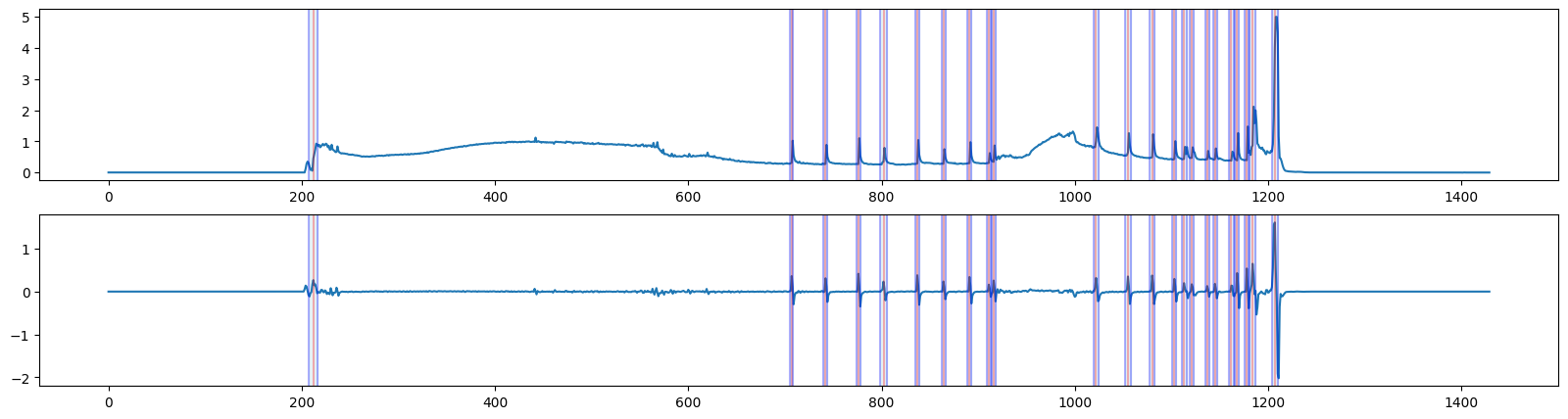
The top plot is Dα signal and bottom one is gradient plot.
profiles = xr.open_zarr(store, group='spectrometer_visible')
signal = profiles['filter_spectrometer_dalpha_voltage'].isel(dalpha_channel=1)
D-alpha refers to the spectral line emission from neutral deuterium atoms when electrons transition from the n = 3 → n = 2 energy level, probably, referring to Bohr’s model.
Where does it come from in a tokamak?#
Most of the plasma is ionized.
But at the edge, some neutral deuterium remains.
When hot electrons or ions from the plasma interact with these neutrals, they excite them.
When these neutrals relax (n=3 → n=2), they emit Dα photons.
What is shown in the plot?#
Left side of the top plot (up to ~700–800 index): This is L-mode — the edge is turbulent, but there’s no strong edge barrier and no large transient drops.
Somewhere between index 700–800: LH transition
Between ~800 and ~1200: The regular spikes in the Dα signal indicates ELM.
Back transition (HL transition): Around ~1200, both plots flatten out.
Edge-localized mode (ELM)#
mini explosion or burst of energy and particles at the edge of the plasma.
plasma instability that occurs at the edge of the plasma in H-mode.
It’s like the plasma periodically burping energy and particles from the edge.
Uncontrolled ELMs can:
Damage divertor plates
Reduce plasma confinement
Potentially trigger other instabilities, such as the resistive wall mode (RWM) or the neoclassical tearing mode (NTM).